Monday, August 26, 2013

Why Flags?

 
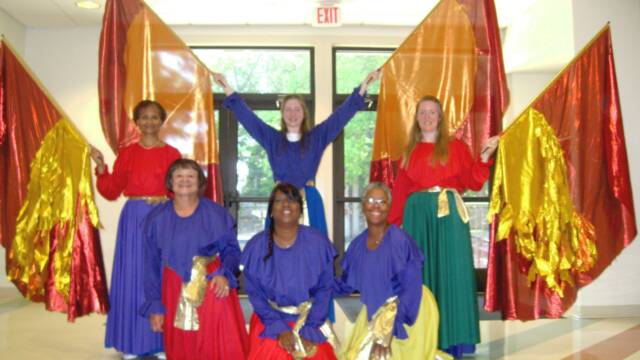
Flag Ministry or Flag Worship is the union of flags, music, and the Word of God that allows one to enter into the awesome presence of God.

This worship art form brings a memorable experience of worshiping our Lord under His anointing.

There are many flags of praise, worship, warfare, prophetic, celebration and dedication and many more. Please note, one can stand still and worship with flags!
In scripture, we learn, flag, banners & etc. can become powerful weapons in the spiritual realm when we worship. "Expressions Of Worship" products are used in Praise and Worship to first minister to Our King and Lord and then to the body of Christ!

There are two reasons or purposes for Flag Worship:

(1) to exalt the name of the Lord and give Him all the praise and the glory, and honor

(2) to destroy the works of the enemy.

Waving flags and streamers under the anointing of God as the Holy Spirit ministers to our hearts, minds, and spirits, which leads us into an unforgettable time of worship with the Lord.

God has a message for us and through Flag Worship is one way He can deliver it.

My passion for silk, the soft feel, the light weight, the movement of the silk during the use in worship, is so graceful and almost effortless, but can be prophetic and powerful to your movement in worship, dance and / or drama.

The colors of the flags are important as you select them for ministry. The meaning and references are many as the Holy Spirit ministers to each person individually. God loves color! Colors have great significance spiritually as they do in the natural realm. Additionally, combinations of colors may also have different meanings. When choosing a color of a flag or streamer, we feel it is important for the dancer to keep in mind the symbolic meaning behind each color and choose according to what his or her spirit is feeling. If you think about the individual color breakouts that it takes to make a color, the symbolization is awesome!
************************************
Article courtesy of Expressions Of Worship

Thursday, August 1, 2013

Flag Ministry


The use of flags can be quite an entertaining sight to see, but when used to lift up blessings, glory, honor, and power to the Lord in His presence, flags can be more than entertaining. Used in accordance to the Word, flags become the primary sign for lifting up a "standard" of God. The Bible refers to the word flag as "standard" or "banner." The Hebrew word degel is translated as, a flag or banner or standard. Degel comes from the Hebrew root word dagal, meaning to flaunt, i.e. raise a flag; to be conspicuous, setting up with banners. Standard is defined as a banner used as an emblem, marker or rallying point; an ensign; military or personal flag. In the Old Testament, God commands Moses to instruct the children of Israel to camp by their own "standard" to signify their tribe. (Numbers 2:2) There were 12 different flags or banners for the 12 tribes. (Numbers 1:52, 2:2-3, 10, 18, 25; 10:14, 18,22, 25) Banner is defined as a flag or cloth standard. It is used figuratively to define one of God's Name's, Jehovah Nissi, the Lord is my banner! God's salvation and truth is declared by the raising of the banners, Psalms 20:5, Psalms 60:4. He is a banner of love and protection described in Song of Solomon 2:4 and reigns with great power, Song of Solomon 6:4, 10. He is a standard and He is calling us to lift up a standard, declare and proclaim it to all the world. (Isaiah 5:26, 11:12, 13:2, Jeremiah 50:2).

Flag Ministry or Flag Worship is the union of flags, music, and the Word of God that allows one to enter into the awesome presence of God. This worship art form brings a memorable experience of worshiping our Lord under His anointing. There are two reasons or purposes I believe for Flag Worship: (1) to exalt the name of the Lord and give Him all the praise and the glory, and (2) to destroy the works of the devil. The basic technique of flag waving is not really a new art form. We see this art displayed in the world in rhythmic gymnastics or in a school's marching band, but waving those same flags and streamers under the anointing of God as the Holy Spirit ministers to our hearts, minds, and spirits leads us into an unforgettable time of worship with the Lord. God has a message for us and through Flag Worship is one way He can deliver it.

How does one begin to praise and worship with flags begins with a desire to praise and worship the Lord. There is no special talent needed to worship with flags, even though having some skills in dance and ballet enhances your worship, but a willingness to use your body for the glory of God definitely is required. What you don't have the anointing will make up for as you present your offering to the Lord. Flag Worship can be done as an individual or group worship. As an individual, you are called on to ministry with several flags and streamers of all sorts while worshipping to a song or sometimes no music, being one with Christ. As a group, you minister as one in Christ even though each person gives their offerings with flags to the Lord in a choreograph worship or spontaneous. Through each worship piece, flags are raised and a "standard" as we know is lifted up for all the world or your audience to see. You or the group become the "bannered one (s) or standard-bearer (s), one who carries an ensign into battle. The types of flag worship pieces are the same and similar to those of dance ministry. There is a flag praise piece, a flag worship piece, a warfare piece, a flag prophetic piece, a flag celebration and dedication pieces, and many more. Notice that I didn't say, "flag praise dance piece", because dance is not a necessary requirement to worship with flags. Therefore, one can stand still and worship with flags!

The ministry comes from the heart! The colors of the flags are important as you select them for ministry. The meaning and references are many as the Holy Spirit ministers to each person individually.

White
- Glory & majesty (Daniel 7:9, Revelation 20:11)
- Purity (Revelation 1:14)
- Completion (John 4:35)

Purple
- Royalty (Judges 8:26)
- Wealth (Luke 16:19

Black
- Sorrow, Calamity (Revelation 6-12)
- Hell (Jude 13

Blue
- Heavenly Character (Exodus 28:31)

Green
- Spiritual Privileges (Jeremiah 11:16)
- Spiritual Life (Psalms 52:8, Psalms 92:12-15)

Red
- Atonement (Isaiah 63:2) - Persecution (Revelation 12:3)
**************************************
Article courtesy of Beit Tehlia Congregation

Wednesday, July 24, 2013

Power of prayer: Niagara’s waters


  • Power of prayer
  • How to pray?

My son Robert, on the precipice of power on the Canadian Falls.

Emerald water look like thick glass, inviting tourists to dip a toe — or even take a swim. The alluring beauty of Niagara Falls belies its power — 6 million cubic feet flows in an irresistible current every minute over the crest. One-hundred-and-sixty-five feet below, as it pounds into the whirling pool, it raises a relentless thunder and mists that bathes people for 100 yards away.


Water leaping from the heights pounds the poor below, raising mists over 200 feet into the air, drenching tourists. Note the boat at the bottom that fits 200 passengers.

Behind the beauty lies true power.

Many look at prayer as a beautiful thing. They fail to perceive its weight of crushing power. Nations have been overturned. Darkness has ceded to radiant light. The onward rush of worldliness has been diverted, the press of sin blunted. Why? Because of prayer.


Oh look! How beautiful! She prays!

To the contrary, look, how powerful: she prays.

In a material world where we are taught to measure scientifically with our five senses, we can forget entirely the unmeasurable life-changing power of prayer. Just because a prayer experiment would be impossible (with one group that receives prayer and the other that does not), we tend to dismiss it.

Where science leaves off, faith picks up and continue to describe the reality of our multi-faceted existence. Pray today! Effect change. Don’t miss the power behind the beauty of prayer.

**********************************
Article borrowed from Mustard Seed Budget at  http://mustardseedbudget.wordpress.com/2013/07/24/power-of-prayer-niagaras-waters/

Thursday, July 11, 2013

From Dr. Spock to Tiger Mom: What to expect from your parenting library

"What if I choose the wrong child guru and ruin my offspring?" new mom Katie Walmsley wrote in the late days of her pregnancy.
Editor's note: Katie Walmsley is a CNN producer and reporter.

(CNN) -- "Congratulations!" people said when I told them I was pregnant with my first child.

Also, usually, "What's your due date? Do you know what it is?"

And then, frequently -- and much to my surprise -- "What book are you reading?"

It turns out you can't just up and have a baby. Many parents are now also subscribing to a particular parenting philosophy, often well in advance their little one's emergence into the world. For a soon-to-be new mom, it was overwhelming. What was the right book? Should I stick with the philosophies that make obvious sense to me, or consider some that seem like more dramatic departures? Did I even need a book at all?

Heidi Murkoff, author of famed pregnancy guide "What to Expect When You're Expecting," argued recently that this quest for guidance in books and online is at an all-time high. In a Daily Mail op-ed headlined "Why I fear for modern mothers," she wrote that it stems from pressure on parents to be the best.

"Society's race for the perfect parenting prize has become all-consuming," she wrote. "Whatever the group, everyone is locked in conflict and judging each other."

Studying books on parenting is really no new phenomenon. Ever since Dr. Benjamin Spock published "The Common Sense Book of Baby and Child Care" in 1946, parents have been reading up on the best way to raise their little ones.

Spock's book was a parenting bible for many years, but also entertained its share of critics, from those who accused him of being anti-feminist, to those who claimed he fostered generations of spoiled brats, to those who blame him for an increase in violent crime. (Kids who grew up thinking it's OK to eschew broccoli probably also think it's OK to steal someone's car ... right?)

But where once there was just Spock to follow (or not, as the case may be), there are now hundreds of parenting books to choose from, most of which seem to ride the same popularity roller coaster as Spock. A book might be celebrated one minute, but a few months down the line, a parent is a pariah for even having it on the shelf.

Parents run the risk of reading a book, only to find it widely discredited mere weeks later. It seemed I had to accept that while books differ on how to parent, they all seem to suggest there's a right way to parent -- and they, the authors, know the secret.

Several friends lent me "The Contented Little Baby Book" by Gina Ford, swearing by the schedule Ford delineates for parents. It includes, in some situations, letting your little one cry for a few minutes. But the idea of "crying it out" now has some detractors wringing their hands as it has become a subject of conflicting research findings.

Another book, Pamela Druckerman's "Bringing up Bebe," touts the French system to raising an independent-minded child who allows you to sleep, have dinner or maybe even a conversation. No-brainer, right? But the author also generated indignation, with one Forbes writer even accusing her of pushing a socialist agenda and ruining all our hopes for future generations of tyke-oons.

Whether it's Amy Chua's push-your-kid method in "Battle Hymn of the Tiger Mother," Dr. Bill Sears' let-your-kid-sleep-with-you plan, Ellen Galinsky's connection-before-correction or Tom Hodgkinson's advice to just chill and have a martini, the messages are different -- but strangely the same: You can screw your kids up, or you can make them great. It's all up to you, and whether you follow these wildly divergent instructions.

Argh-gulp panic-middle-of-the-night-cold-sweat-anxiety. What if I choose the wrong child guru and ruin my offspring? Can you mix and match philosophies? What if by mixing and matching you just create some kind of a babymonster? What if I (gasp) don't read anything at all?

"In terms of controversies and the bombardment of information, [the prevalence of so many conflicting parenting books] is making things too complicated and very un-relaxing for parents", says Dr. Richard Weissbourd, who teaches at Harvard University's Graduate School of Education and author of "The Parents We Mean To Be."

In his book, Weissbourd looks at the pathologies parents themselves bring to the table, rather than just examining ways to parent.

The book also examines the idea of "over-parenting." He believes many parents are too affected by "the Joneses." Not only are they feeling competitive in terms of what they've read, but they worry that by not not taking the same approaches as other parents, they're cheating their child out of opportunities.

Trying to the absolute best parent can actually be damaging to children, the books suggests, and possibly pointless: There are no blanket ways to parent and there is often no right or wrong approach, Weissbourd argues.

"Books often tend to be too generic and get into all these debates," he said. " It's more like, 'Who is my child and how can I be most constructive given what's going on with them?'"

Will Ferrell, in a "Nerdist" podcast, talks about how as a child he refused to take part in a gifted academic program at school, because it would interfere with his square-dancing classes. Ferrell's mom did not dissuade him, as some parents might have, and of course now he's, well, Will Ferrell.

I wondered how Ferrell would have turned out if Amy Chua was his mom? Or what a Sophia Chua-Rubenfeld raised in the Ferrell household would look like? Possibly not at Harvard, like Chua, or on on "Saturday Night Live," like Ferrell.

"There are certain things that are fundamental and if you do them reasonably well, the chances are your kid will be fine," Weissbourd says. "Spending time, being warm, listening, creating reasonable expectations, caring for people, caring for yourself. Safeguarding your child's health and knowing basic health information."

It sounds a lot like ... Dr. Spock.

Spock tells parents in the first chapter: ''Don't be afraid to trust your own common sense. What good mothers and fathers instinctively feel like doing for their babies is usually best."

So, I don't need a book? No need to read chapter two? Just do whatever I think is best?

Perhaps.

Weissbourd points out that this hyper-concern with reading parenting guides is largely divided among cultural and economic lines, and tends to be more of a middle- and upper-class issue. It's not that parents don't need guidance, he said, it's about where that guidance comes from.

He believes parenting in the United States has become too private. Parents will gladly read books, but balk at feedback from people they know. We've all heard the line: "Don't tell me how to raise my child!"

The takeaway, according to Weissbourd, is not to ignore parenting books altogether, which can sometimes offer practical tips, but that the best advice comes from those around you who know you and your little one. Not only is your child unique, but parents might be bringing their own issues to the table, and those might need to be assessed on a case-by-case basis.

Consult a trusted pediatrician, consult people whose opinions you respect, consult your partner, Weissbourd advises. Find time to pause and reflect -- he advises, adding, "I think everybody has got to relax."

For me and my new life with a newborn, the most appealing books turned out to be those where I could find an answer quickly. In Marc Weissbluth's "Healthy Sleep Habits, Happy Child," I skipped the chapters that explained why sleep matters -- that seems startlingly obvious -- and went straight to the week-by-week instructions. The standard "Your Baby's First Year" by the American Academy of Pediatrics and Murkoff's "What to Expect..." books have been very helpful. I relied quite heavily on the Internet to give a variety of answers, making sure to check any advice with my pediatrician.

With a baby, I think it's less about personality, more about practical help. I think the real market for parenting books is parents with older children. Parents of babies reading about what kind of parent to be are probably, like me, likely to gravitate toward books that espouse theories they probably already believe. I read "Bringing up Bebe," because it resonated with ideas I already have about parenting, like teaching kids to enjoy "grown-up" foods from an early age (I might eat my words if my little one refuses everything but chicken fingers.) I like the idea of having a well-behaved child, as I imagine do most people.

This is all very well and good in theory, but I think it's important to read a book that's realistic to the specific situation. Even though I liked "Bringing up Bebe," it just might not be appropriate if my child is exceptionally shy. If a child has attention deficit hyperactivity disorder, for example, then reaching for Chua's "Battle Hymn" may not be the best shot.

When faced with parenting hurdles further down the line, there won't be one easy answer, one book with all the fixes. I like to think I'll take the same approach I do as a journalist -- read several source, know what advice and opinions are out there, whether books, articles or conversations with other parents and my doctor.

Most important, I think, as Dr. Spock advised years ago, I'll go with my gut.
*********************************************